Harnessing technology
Crisis areas around the world, like Ukraine and Angola, continue to struggle with large-scale explosive contamination. A leap forward in innovation is required to tackle this enormous challenge.
The equipment that HALO uses to identify and dispose of explosives has significantly evolved over the last three decades. We're always seeking opportunities to harness evolving technologies to streamline or enhance our life-saving work.
Our five-year technology strategy focuses on four vital areas to transform our operations. These advances will equip our 8,000+ staff to work more safely and efficiently.
Our focus areas:
- Location: identifying hazards
- Detection: avoiding false alarms
- Excavation: safe mechanical digging
- Information: digital-first approach
Our December 2024 'Clearing the path' report gives more detailed information on how we harness technology to clear land and return it to the local community.
Location: identifying hazards
It's important that we pinpoint hazardous areas accurately so we can apply our resources effectively. Traditional surveys are now strengthened by drones, satellites and sensors that can detect mines, even through vegetation.
We're moving to an imagery-first approach. Over the next five years we will:
- Deploy advanced drone sensors that detect buried items and contamination
- Refine machine learning models that interpret imagery and deliver quick results to field teams
- Shift to a fully digital survey workflow to reduce time spent in the field
Our partnership with Trimble has helped us to speed up safe clearance by equipping more teams with precise mapping tools.
In Angola, we use drones with LiDAR and multispectral sensors for forest preservation research in the Cubango Okavango.

Using Trimble equipment in the field
Detection: avoiding false alarms
Learn about our MRead partnership
Detectors used today are highly sensitive, which leads to many false alarms. Reducing these false positives is one of the fastest ways to improve productivity in mine clearance.
We're testing and deploying new sensor technologies to suit different soil types and environments. These include:
- Magnetic resonance sensors that directly detect explosives inside plastic mines
- 3D metal detection that distinguishes unexploded ordnance from harmless scrap
- Early-stage innovations such as neutron-based detection
Trials of MRead detectors in Angola showed clearance rates up to 30% faster than traditional methods.
Excavation: safe mechanical digging
Excavation is the most dangerous and time-consuming phase of demining. In 2024, HALO teams carried out more than 6 million hand excavations. Most demining accidents occur during this stage.
Trials in Zimbabwe and Angola showed that small micro excavators can safely remove mines in under a minute. We're planning to adopt this approach globally over the next few years.
We're also introducing remote-control and automated machines that can operate safely around larger explosives.
Over the next five years we will:
- Work with industry partners to adapt remote controlled and semi-automated systems for micro excavators
- Introduce operator assistance technologies for larger machines clearing whole minefields
- Adopt emerging automation tools from construction, mining and agriculture across our mechanical fleet
Robocut machines remove vegetation ahead of detectors and cut through tripwires. This commercial technology can be adapted for demining with only minor modifications, like remote camera systems. This improves the safety and speed of mine clearance.
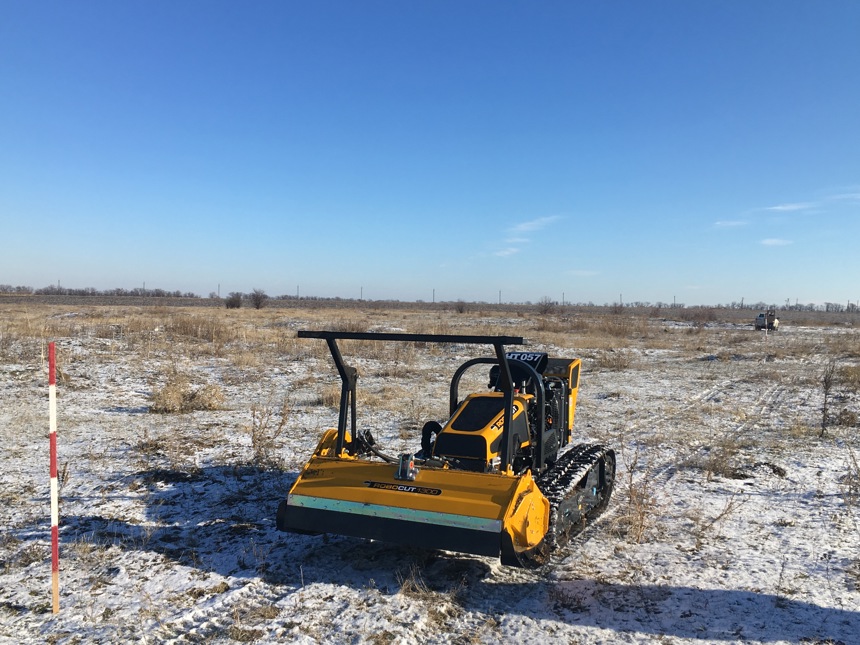

Robocut mechanical demining equipment
Information: digital-first approach


GIS technology and thermal imaging help us to locate and identify landmines
Reliable data drives better planning, safer operations and continuous improvement. HALO has deployed a global operations system, which is used by 1,200+ staff to map cleared areas. This system is accurate to within a metre.
As mobile networks and device access expand, we'll deploy new digital tools to support daily operations, logistics and maintenance. Over the next three years we will introduce:
- Fully digital mapping and reporting workflows
- Direct integration of data from machines and sensors
- Links to fleet, supply chain, and personnel systems
- Planning tools that include digital twins of worksites
These tools give teams the information they need to prioritise their efforts effectively.
Our efficiency depends on strong systems across the organisation. With 8,000+ staff and 1,000+ vehicles, HALO relies on robust logistics, fleet, maintenance and HR systems.
Over the next three years we'll modernise global systems for supply chain, fleet and asset management, and HR. We'll harness AI tools across fundraising, finance, operations and training, while prioritising security, responsible use and cost effectiveness.
More technology stories

The HALO Trust is helping eradicate the dangers of landmines
HALO is working with AWS to clear landmines faster using drone technology and AI.

Boosting landmine clearance with field-focused workflows
The HALO Trust has used geospatial technology to fulfill its mission of safely clearing landmines from civilian land.