Cambodia

History of Minelaying

Although there was limited minelaying between the late 1960s and mid 1970s, the first significant use of landmines did not occur in Cambodia until the 1979 – 1989 Vietnamese occupation.

In December 1978 Vietnam intervened and the Khmer Rouge retreated to, and fought to defend, base camps along the north-west border. Then, through a series of dry season offensives in 1984-1985, the Vietnamese military drove the Khmer Rouge (and 230,000 civilians) across the border into Thailand. To impede the return of the Khmer Rouge tens of thousands of local people were forcibly conscripted over 18 months into assisting in the construction of a barrier minefield along the entire 750 kilometer length of the Cambodia-Thai border.

This fifth in a series of defensive plans (Kar Korpier pram) has become known infamously as “the K5”. During the decade that culminated in the final collapse of the remaining Khmer Rouge leadership (Anlong Veaeng, December 1998) further landmines were laid by State of Cambodia forces to defend towns and villages, military positions and supply routes from attack by opposition forces. In the same period Khmer Rouge and Monarchist opposition forces used landmines to protect newly won ground or to contaminate the interior of abandoned Vietnamese defensive positions.

The Problem

Over 64,000 landmine and ERW casualties have been recorded in Cambodia since 1979, and with over 25,000 amputees, Cambodia has the highest ratio per capita in the world.

Despite a considerable reduction in casualty numbers over recent years, down from 875 in 2005 to 211 in 2011, Cambodia’s mine and ERW problem still represents a major impediment to the social and economic development of the country. However, given more than two decades of humanitarian demining, the landmine threat is now largely concentrated in just 21 north-west border districts.

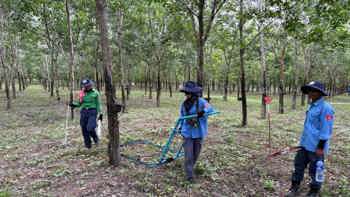
In these rural districts the landmine problem continues to negatively affect much needed development by hindering access to:

· Land for agriculture and resettlement
· Infrastructure and basic social services
· Irrigation and safe drinking water
· Secondary and tertiary roads
· Land for cattle raising and foraging for forest products, as well as
· Placing financial and emotional hardship on families needing to care for a landmine survivor
· Causing psychological trauma for those forced to live alongside such a threat

Requirement for continued clearance

The results of Cambodia’s Baseline Survey are due to be published in early 2013. Findings to date have confirmed that there are many hundreds of km that require mineclearance in order that communities can live in safety.

As well as the continued requirement for accurate survey there is a requirement for more deminers in order to speed up clearance.

HALO Cambodia and the mine impacted communities we serve are grateful for current funding from the governments of Belgium, Finland, Ireland, New Zealand, The Netherlands and The United States of America and the multi-donor Clearing For Results project implemented by the Cambodia Mine Action and Victim Assistance Authority (CMAA). Significant donations are also provided by private groups and foundations including Freedom Fields USA, Rotary International, the Gould Family Foundation and the Hurvis Charitable Foundation.

We would like to thank current donors for their ongoing support and encourage new donors to support HALO’s life saving work.

Program management - Senior staff

Armen Harutyunyan

Program Manager

Armen has worked in Mine Action for over 12 years in operational and programme-management positions in Afghanistan, Kosovo, Lebanon, Nagorno-Karabakh, Somaliland, Sudan and Tajikistan. He deployed to Laos in June 2012, to set-up and manage HALO’s UXO clearance programme. Armen holds a bachelor’s degree in humanities.

Leng Saren

HALO Cambodia Program Operations Manager

Leng has worked for HALO since 1992. After starting as an interpreter Leng worked his way up to the position of Location Manager before taking on the Operations Manager position in 1999. Having had primary responsibility for mineclearance operations for over a decade, Leng remains one of our most experienced senior managers. Masters in Commerce.

Smann Makara

HALO Cambodia Location Manager

Makara has worked for HALO since 1994. Makara began his HALO career as a deminer. After three years demining he was promoted to a Section Commander. Three years later, after a period as the program's Training Officer, he started as a Location Manager. Since 2001 Makara has controlled HALO's Banteay Meanchey provincial operations.