Afghanistan
Afghanistan is a mountainous country, that sits at the crossroads of Central and South Asia. It shares borders with six countries, including Pakistan, China, and Iran.
Our work here began in 1988, as the first programme of our newly-founded charity. Our focus was initially mine clearance, expanding into risk education in 2002. In recent years, we are increasingly providing humanitarian aid too.


Situation in Afghanistan
The Afghan people have faced many challenges in recent years. In 2025, around 23 million people were in need of humanitarian assistance, which is over half the population.
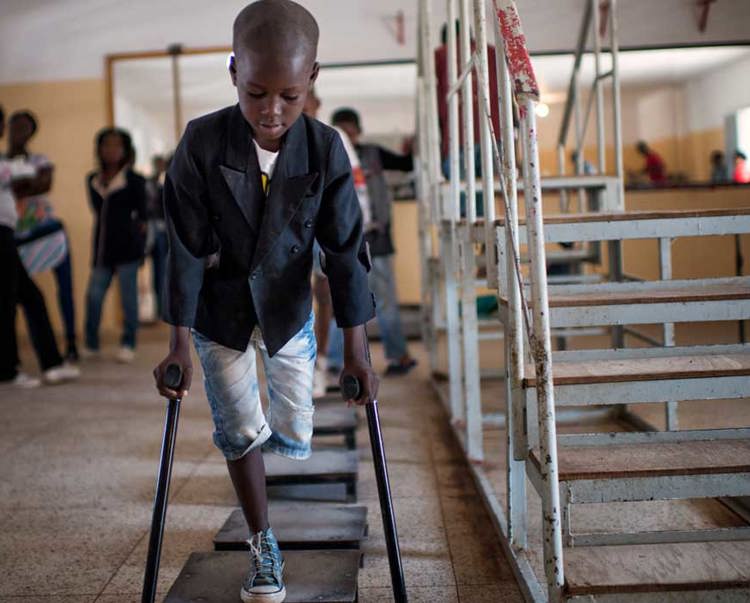
Multiple conflicts from 1979 to 2021 have all left explosive dangers behind. Families are forced to farm dangerous land to survive, or sell explosive remnants as scrap metal. There are at least 50 civilians killed or maimed by explosives in Afghanistan each month.
Afghanistan is also one of the countries hit hardest by the impact of climate change. This has sparked unpredictable weather patterns, flash floods, landslides, snow storms, and droughts. Millions of Afghans risk losing their livestock, crops, and livelihoods from these natural disasters.
In May 2024, the northern, north-eastern, and western parts of Afghanistan were severely flooded. Hundreds of lives were lost, critical infrastructure was damaged, and homes and farming land were submerged.

Children whose home was used to store explosives, Kandahar
"When the flood hit, it came from all directions. We were forced to climb onto the roof to survive. When the water rose above the roof, it took all of us under. Fortunately, we survived, but we were seriously injured and now we can’t take care of ourselves."
HALO's work and impact in Afghanistan
HALO has worked in Afghanistan since 1988. Our programme is completely Afghan-led, with a multi-ethnic workforce spread across the country. We currently employ around 1,000 staff, who support 10,000+ dependents. Their employment often provides much-needed financial assistance in their communities. HALO's female staff work primarily in our mixed-gender risk education teams. They provide life-saving training on explosives to adults and children.
HALO Afghanistan has destroyed almost 860,000 landmines, and over a million other explosives. We’ve cleared 138,000 hectares of land, enabling farmers to graze cattle and grow crops. That’s an area 400 times the size of New York’s Central Park. Along with the Mine Action Programme of Afghanistan, we’ve made safe almost 80% of the country's minefields.

HALO deminers in Afghanistan
Play interview with HALO CEO on DW News
HALO's current operations
Since the end of large-scale fighting in 2021, we’ve been focused on clearing land around schools and clinics. We also provide safe clearance to scrap-metal factories, where unexploded munitions are a major hazard.
In West Kabul, we spearheaded one of the biggest urban clearance operations since WWII. This enabled the city, that had been decimated by war, to rebuild.
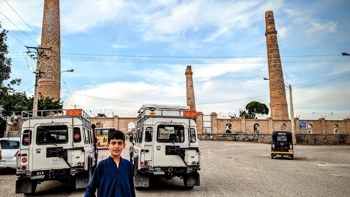
In Herat Province, we cleared over 600 minefields, including land around the 15th century minarets of the Husain Baiqara Madrasa.
HALO is increasingly responding to floods, earthquakes, and other natural disasters in Afghanistan. We help to provide emergency aid to the most affected people.
A local farmer's view
Zhari district in Kandahar province has been a battleground throughout many years of conflict. This has left the area highly contaminated with deadly explosives, hindering livelihoods for decades.
In this video, local farmer Abdul Rashid describes how the area had been deserted for fear of landmines. After HALO deminers cleared 23 sq km of land, the village was declared safe and local livelihoods were restored.
Learn about Abdul's story
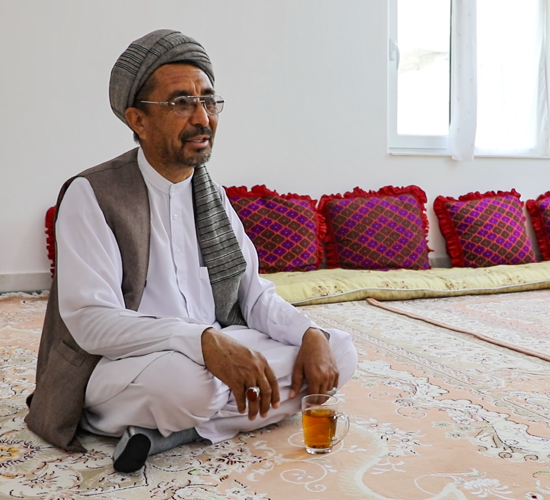
"The mines left us feeling in danger. We were here when HALO cleared the area. They worked tirelessly to clear the entire area of mines. After clearance, people felt safe. Construction and investment started. Schools, parks and clinics were established, providing opportunity for people to live good lives here."
HALO's work in Afghanistan is funded by: